
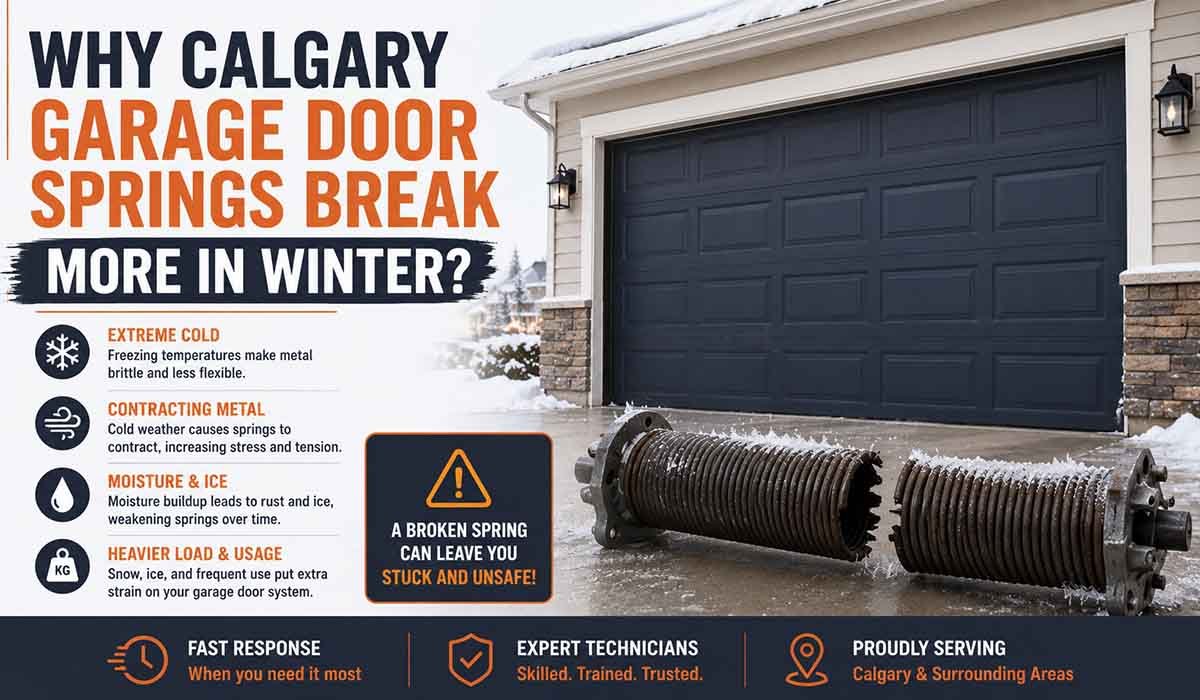
You heard it at 6 AM. A loud bang from the garage, like someone slammed a heavy door. You go check and everything looks fine. Then you press the button and the opener runs but the door barely moves, or does not move at all. If your opener runs but the door will not move and there was no loud bang, the cause may be the opener itself rather than a spring.
That sound was your torsion spring breaking. And if it happened in the middle of the night or early morning during a cold snap, that is not a coincidence. There is a reason Calgary garage door springs fail in winter more than any other time of year, and it comes down to something specific about this city that most homeowners have never thought about.
The Chinook Factor: Why Calgary Is Different
Most places in Canada that get cold winters deal with consistent cold. Edmonton drops to minus 30 and stays there for weeks. Calgary drops to minus 30 and then a chinook rolls through and it is plus 5 the next afternoon.
Calgary gets between 30 and 35 chinook events per year. Some of those events bring temperature swings of 20 to 30 degrees Celsius inside a single day. That pattern is what makes Calgary so hard on garage door springs, and it is a problem that does not get talked about much outside of the people who actually fix garage doors here.
Here is what is actually happening inside the spring:
Metal Fatigue From Thermal Cycling
Torsion springs are made of hardened steel coil. Steel expands when it heats up and contracts when it cools down. In a steady climate, that movement is minimal. In Calgary, the spring goes from fully contracted at minus 25 to expanded at plus 10 and back again, sometimes within 36 hours. Do that 30 to 35 times a year, year after year, and the coil develops micro-fractures in the steel. That is metal fatigue. It does not happen all at once. It accumulates.
Eventually the spring fails at the point where those micro-fractures have built up the most, usually at the stationary cone on one end. And because that fatigue accumulates over months, the spring tends to fail during the worst possible conditions, often in the dead of night when temperatures are at their lowest.
Lubricant Failure at Extreme Cold
At minus 30, most standard greases and oils thicken significantly. A spring that is running without adequate lubrication wears faster. When temperatures drop hard after a chinook event, the lubricant that was fine at minus 5 is not doing much at minus 28. The coils are essentially grinding together under load.
This is one reason we recommend a silicone-based garage door lubricant over regular grease. Silicone stays fluid at much lower temperatures than petroleum-based products and holds up better through the temperature cycling that Calgary sees every winter.
Why Springs Fail at Night
The coldest point of any day is usually between 3 and 6 AM. That is when the steel has contracted the most, when the lubricant is at its least effective, and when the fatigue in the coil is being stressed at the tightest point. A spring that was holding together at minus 15 during the evening may give out at minus 28 a few hours later.
This is why so many spring failures in Calgary happen while the door is sitting closed. The spring is not moving. It is just sitting there under tension, in the cold, at the worst possible point in its fatigue cycle. Something gives and the coil snaps.
The loud bang homeowners report is the coil releasing stored tension instantly when it breaks. It sounds much worse than it is structurally, but it does mean the door will not open safely until the spring is replaced.
How Calgary Usage Rates Speed Things Up
A standard residential torsion spring is rated for 10,000 cycles. One cycle is one open plus one close.
In most Canadian cities, a garage door opens and closes about 3 times a day, roughly 1,000 cycles per year. A 10,000-cycle spring lasts about 10 years.
In Calgary where the garage is the main entrance and residents are commuting on Deerfoot or Macleod, the average is closer to 4 to 6 cycles per day. That is 1,500 to 2,000 cycles per year. The same 10,000-cycle spring lasts 5 to 7 years.
Combine that shortened lifespan with the additional metal fatigue from chinook cycling, and you have springs that are often failing years earlier than the same product would in another part of the country.
| Usage Pattern | Estimated Spring Lifespan |
| 3 cycles per day (national average) | 10 years |
| 4 cycles per day (typical SE/SW Calgary) | 7 years |
| 5 to 6 cycles per day (high-use Calgary home) | 5 to 6 years |
| 5 to 6 cycles per day with chinook fatigue factor | 4 to 5 years realistically |
Signs Your Spring Is Getting Close to Failure
Springs rarely fail with zero warning. There are usually signs in the weeks before. The problem is that most homeowners do not know what to look for.
- The door feels heavier when you lift it manually: Disconnect the opener by pulling the red emergency cord. Try to lift the door by hand from the bottom. A properly balanced door should go up with 10 to 15 lbs of effort at most. If it feels much heavier than that, the spring tension is dropping.
- The door moves unevenly: One side rising faster or higher than the other often means one spring has more tension than the other, which can happen as springs wear at slightly different rates.
- The opener is straining: If your opener sounds louder or slower than it used to, it may be compensating for reduced spring tension. The motor is working harder because the springs are not carrying their share.
- Visible gaps in the coil: Walk over and look at the spring above the door. If you can see a gap in the coil where the wire has separated, that spring has already broken. Do not use the door.
- The door drops too fast when closing: A properly tensioned door should lower gradually. If it drops faster than usual, spring tension is low.
What to Do When a Spring Breaks
If you hear the bang and the door will not open properly, here is what to do:
- Do not force the opener. Running the motor against a door without functioning springs will burn out the motor. Stop pressing the button.
- Pull the red emergency release cord. This disconnects the door from the opener. The cord hangs from the trolley on the ceiling rail.
- Try to lift the door manually. With a broken spring, a standard door will feel extremely heavy, often 80 to 100 lbs or more without spring assistance. Do not try to force it open.
- If the door is closed and your car is inside, call for service. Most Calgary garage door companies, including us, offer same-day service for broken springs. In a pinch, some newer openers have a battery backup mode that can cycle the door once even with a broken spring, but do not rely on this repeatedly.
- If the door is stuck open, call immediately. An open door in Calgary winter is a security issue and a heating issue. This is an emergency call, not something to leave overnight.
Should You Replace One Spring or Both?
If you only have one spring and it broke, you replace it. But most double-car garage doors have two springs, and this is where a lot of homeowners get the wrong advice.
Both springs have been through the same number of cycles. Both have gone through the same chinook temperature swings. Both have the same metal fatigue built up. The one that did not break is not in better shape than the one that did. It is just a few weeks or months behind.
Replacing only the broken spring saves $80 to $100 upfront. It also means you will have another service call, another trip fee, and another hour of someone’s time within the next year or two. Any reputable Calgary garage door company will replace both. If someone is pushing you toward single-spring replacement on a two-spring system, ask why.
What About High-Cycle Springs?
Standard springs are rated for 10,000 cycles. High-cycle springs are rated for 25,000 to 50,000 cycles and cost more upfront, typically $60 to $100 more per spring.
For Calgary homeowners who use the garage as the main entrance, the math is worth doing. At 1,800 cycles per year, a 25,000-cycle spring lasts about 14 years. A 50,000-cycle spring could last the life of the house. The extra cost upfront is a fraction of two or three replacement jobs over that same period.
High-cycle springs also tend to use heavier-gauge wire, which handles thermal cycling better. For Calgary’s specific conditions, they are worth considering.
A Quick Note on DIY
Torsion springs are under serious tension. When they break, they release that tension instantly, which is the bang you hear. Winding and unwinding springs during installation requires specific winding bars and specific technique. A mistake does not result in a minor injury. We are not being dramatic about this. It is one of the few garage door jobs we would say clearly: do not attempt it yourself unless you have training and the right tools.
What This Repair Costs in Calgary
For a full breakdown of what garage door repairs cost in the city, including spring replacement, see our complete Calgary garage door guide. As a quick reference, replacing both springs on a standard residential door typically runs $250 to $380 from a legitimate Calgary company.
Need a spring replaced today? Call Fish Creek Garage Door Repair Calgary at 587 893 3737. We offer same-day service across Calgary.
