
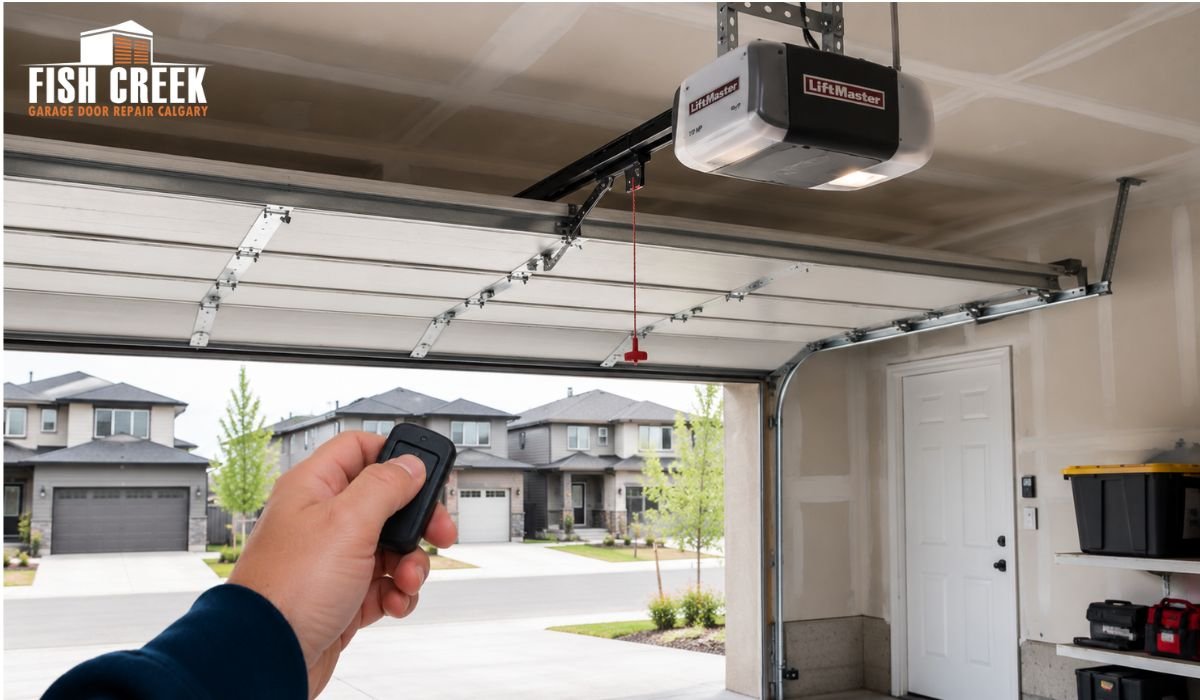
It is 7:10 in the morning in Calgary. The car is packed, the Deerfoot commute is already backing up, and you press the remote. Nothing. You press it again from inside the car, then from the wall button. The door sits there. The opener light might flicker, the motor might hum, or the whole unit might be dead silent. Either way, you are now standing in a cold garage with a door that will not move and a workday that started ten minutes ago.
A garage door opener that stops working is one of the most common calls we get across SE and SW Calgary, and the good news is that a large share of these problems are simple to identify at home. Before you assume the worst, this guide walks you through the same diagnostic order a technician uses, from the fastest checks to the ones that need tools. Work through it in order and you will usually know within a few minutes whether you are looking at a dead battery, a frosted sensor, or a genuine repair.
| Quick answer: why is my garage door opener not working?
In Calgary, a garage door opener that will not respond is most often caused by one of six things: dead remote or keypad batteries (which drain faster in cold), a tripped outlet or breaker, misaligned or frost-covered safety sensors, a disengaged trolley, worn drive gears, or travel and force settings knocked off by a heavy, cold door. Test the wall button first. If the wall button works but the remote does not, the problem is the remote. If nothing works at all, start with power. |
First, is it the opener or the door itself?
Before you troubleshoot the opener, confirm the opener is actually the culprit. Pull the red emergency release cord to disconnect the door from the trolley, then lift the door by hand. A balanced door should glide up smoothly and stay open on its own around waist height.
If the door is heavy, drops on its own, feels like it is fighting you, or will not move at all, the problem is not your opener. You are most likely looking at a broken spring, a snapped cable, or a door that has come off track. In that case the opener is innocent, and forcing it to lift a dead-weight door will only burn out the motor. Springs take the brunt of Calgary’s freeze-and-thaw cycles, so this is a frequent finding in older homes across Shawnessy, Bridlewood, and McKenzie Towne.
If the door lifts by hand smoothly, reconnect the trolley and carry on. The fault is in the opener system, and the steps below will find it.
Step 1: Does the opener actually have power?
If the opener is completely silent, with no lights and no motor hum, treat it as a power problem first. This is the single most overlooked cause, and it costs nothing to check.
- Confirm the opener is plugged in. Vibration over months can back a plug partway out of the ceiling outlet.
- Test the outlet with something else, like a phone charger or a work light. Many garage outlets in Calgary homes are GFCI protected, and a tripped GFCI (sometimes on a bathroom or exterior receptacle down the line) will kill power to the opener. Press the reset button.
- Check the breaker panel for a tripped garage circuit. A cold snap that has every block heater and space heater running can push a circuit over its limit.
If the outlet is dead and the breaker will not stay reset, stop and call an electrician. A repeatedly tripping circuit is a wiring issue, not a garage door issue.
Step 2: Are your remote or keypad batteries dead?
If the wall button opens the door but the remote or the outdoor keypad does not, you have found your answer: the problem is battery power, not the opener.
Cold is the reason this happens so often here. Battery capacity drops sharply as temperature falls, and a coin-cell or alkaline battery that tested fine in October can go flat on the first -25°C morning. Remotes left in a vehicle overnight and keypads mounted outside on the garage frame are the most exposed. Calgary sees dozens of deep-cold days each winter, so a remote that dies in January often just needs a fresh battery, not a service call.
- Swap the remote battery for a fresh one. Most use a CR2032 coin cell or a small 12V (23A/27A) battery.
- Replace the outdoor keypad battery and check for moisture or ice inside the housing.
- Store a spare remote inside the house. If the spare works and the car remote does not, you have isolated the fault cleanly.
Step 3: Are the safety sensors blocked or misaligned?
If the door opens fine but will not close, or closes a few inches and then reverses back up, the safety sensors are the prime suspect. Since 1993, every residential opener sold in North America has been required to have a pair of photo-eye sensors mounted near the floor on each side of the door. They shoot an invisible beam across the opening, and if anything breaks that beam the door refuses to close. It is a safety feature working exactly as designed, even when the cause is harmless.
In a Calgary winter, the usual triggers are:
- Frost, snow, or condensation on the sensor lens after a chinook thaw and refreeze.
- A sensor knocked out of alignment by a snow shovel, a bike, or a stack of storage bins.
- A salty slush film on the lens from boots and tires.
Check the small LED on each sensor. On most units, a steady light on both sensors means they are aligned; a flickering or dark light means the beam is broken or the sensors are pointed away from each other. Wipe both lenses gently with a dry cloth, clear anything in the door’s path, and nudge one sensor until both lights hold steady. This alone resolves a large share of winter no-close calls.
Step 4: The motor runs but the door will not move. Now what?
If you hear the motor working but the door stays put, the drive system has lost its connection to the door. Two causes are common.
The trolley is disengaged
If you pulled the emergency release earlier and never reconnected it, the opener is running the carriage up and down the rail without grabbing the door. Pull the release cord toward the door and either reattach it manually or run the opener until the trolley clicks back onto the carriage.
A worn drive gear or a broken belt or chain
Belt and chain drive units have a plastic drive gear that wears out over years of use. On a screw-drive unit, the trolley can strip. If you hear a grinding or whirring with no movement, the gear has likely failed. This is a repairable fault, but it needs the right replacement part for your opener model, so it is a technician job rather than a roadside fix.
Step 5: Are the travel and force limits set correctly?
Openers have adjustable settings that tell them how far to travel and how much force to use. Cold weather quietly disrupts both. As temperatures drop, lubricant on the tracks and hinges thickens and the door gets physically heavier to move. The opener senses the extra resistance, decides something is in the way, and stops or reverses to protect against crushing an obstacle.
Signs your travel or force settings need attention:
- The door reverses before it reaches the floor, or stops partway up.
- The door slams down harder or faster than it used to.
- The behaviour is worse on the coldest mornings and improves as the day warms.
If the door only reverses on the very first try on a freezing morning, though, the cause may not be the settings at all but a garage door frozen to the concrete, which needs thawing rather than a force adjustment.
The force and travel adjustment dials or buttons are usually on the back of the motor unit. Before you adjust anything, though, fix the root cause: a door that is heavy because of thickened grease or dry rollers should be serviced, not muscled through with a higher force setting. Cranking up the force to overpower a stiff door removes the very safety margin the setting exists to protect.
Step 6: The wall button works but the remote will not. Is it the opener?
No. If the wall button operates the door and only the remote or keypad fails, the opener motor is fine. You have already ruled out power, sensors, and the door itself. Work through these in order:
- Replace the remote battery (Step 2) if you have not already.
- Check for a lock or vacation mode. Many wall consoles have a lock button that disables remotes on purpose. A blinking indicator light on the wall unit is the usual tell.
- Reprogram the remote to the opener. Hold the LEARN button on the motor unit, then press the remote button within the time window. The exact steps are printed inside the light cover or in the manual for your LiftMaster, Chamberlain, Genie, or other model.
- Rule out interference. LED shop lights and some smart bulbs can jam opener frequencies. If the remote works up close but not from the driveway, radio interference is a likely cause.
Why do garage door openers fail more often in Calgary winters?
Calgary is genuinely hard on garage door systems, and openers feel it along with everything else. The city sees roughly 30 to 35 chinook events a year, and the rapid temperature swings, sometimes 20 to 30°C in under a day, put components through constant expansion and contraction. Service calls across the trade spike by 187 to 280% during major cold events, and openers are dragged into the failure rate for three reasons:
- Cold drains battery power in remotes and keypads, causing intermittent no-response faults.
- Thickened lubricant and stiff springs make the door heavier, tripping force limits and straining the motor.
- Frost and refreeze cycles fog the safety sensors, producing the classic winter symptom of a door that opens but will not close.
Homes in the newer SE and SW communities, including Auburn Bay, Legacy, Mahogany, and the Fish Creek area, often came with builder-grade openers and hardware that are now reaching the age where these faults cluster together. For the full picture on how Calgary’s climate wears on every part of your door, from springs to seals, see our complete Calgary garage door guide.
When should you call a Calgary garage door technician?
Handle these yourself: dead batteries, tripped GFCI or breaker, dirty or nudged sensors, a disengaged trolley, and remote reprogramming. Call a professional when you see any of the following:
- The door is heavy or will not lift by hand, pointing to a spring or cable failure. Springs are under extreme tension and are dangerous to handle without training.
- The motor grinds or whirs with no movement, indicating a worn drive gear or stripped trolley.
- A circuit trips repeatedly, which is an electrical fault, not a door fault.
- The door reverses or behaves erratically after you have cleaned the sensors and checked the path.
- You are locked out in the cold with a car trapped inside. In Calgary, that is a genuine emergency, not an inconvenience.
| Still stuck? We cover SE and SW Calgary the same day.
If you have worked through these steps and your opener still will not cooperate, our technicians handle opener repairs, sensor and gear replacements, and spring failures across Cranston, Auburn Bay, McKenzie Towne, Shawnessy, Legacy, Mahogany, and the wider Calgary areas. Call Fish Creek Garage Door Repair for a free, honest quote, or book online and we will get your door moving again. |
Frequently Asked Questions
Why does my garage door opener work sometimes but not others in winter?
Intermittent operation in cold weather usually points to weak batteries in the remote or keypad, since battery capacity drops as the temperature falls. It can also be marginal safety sensors that fog up after a chinook thaw and refreeze. Replace the batteries first, then clean and realign the sensors.
My garage door opens but will not close. What is wrong?
A door that opens but reverses or refuses to close almost always has a safety sensor problem. The photo-eye sensors near the floor detect a broken beam and stop the door from closing. Wipe both lenses, clear anything in the door’s path, and adjust the sensors until the alignment lights on both hold steady.
The opener motor runs but the door does not move. Is the motor broken?
Usually not. The most common cause is a trolley that was left disconnected after the emergency release was pulled. Reconnect it and test again. If the motor grinds or whirs with no movement, a worn drive gear or stripped trolley is likely, which needs a technician and the correct replacement part.
How do I know if it is the opener or a broken spring?
Pull the emergency release cord and lift the door by hand. If it glides up smoothly and holds around waist height, the door is balanced and the fault is in the opener. If it is heavy, drops, or will not move, you likely have a broken garage door spring or cable, which is a repair for a trained technician, not the opener.
Can cold weather really stop my garage door opener from working in Calgary?
Yes. Calgary’s deep cold and frequent chinook swings drain remote batteries, thicken lubricant so the door gets heavier and trips the opener’s force limit, and cause frost on the safety sensors. These are among the most common winter opener faults in SE and SW Calgary, and most are quick to fix once you know where to look.
Is it safe to adjust the force settings on my garage door opener myself?
You can adjust travel and force settings, but do it carefully and only after ruling out a heavy or poorly lubricated door. Turning the force up to overpower a stiff door removes the safety margin that stops the door from crushing an object or person. If the door is heavy, service the door rather than increasing the force.
