
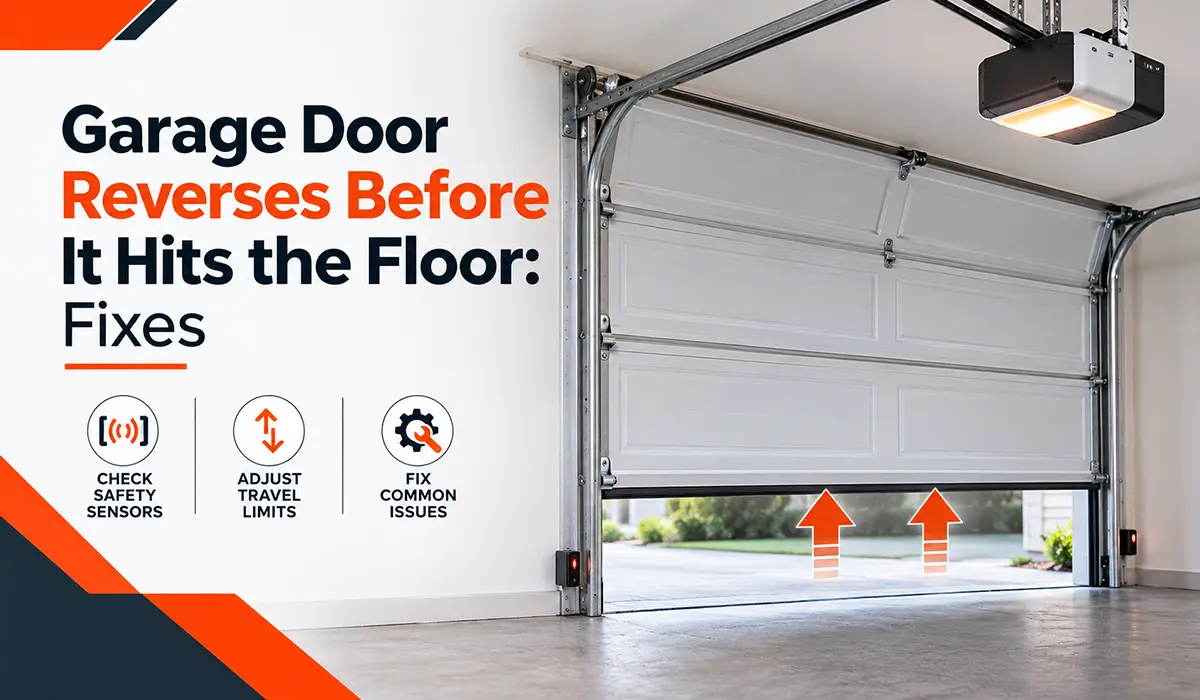
A garage door that reverses just before it hits the floor is reacting to something it thinks is in the way. The most common causes are a down travel limit set too far, a close force setting that is too low, ice or debris on the floor, a stiff or frozen bottom seal, and photo-eye sensors that are dirty or out of line. Clear the floor, clean and check the sensors, then look at the limit and force settings in small steps. If the door still reverses, or if it feels heavy or crooked, stop and call a professional, because the cause may be a spring, a cable or the opener itself.
This guide walks you through the causes in the order we check them, shows what is safe to try yourself, explains why Calgary winters make this problem more common and tells you when it is time to call.
Why a Garage Door Reverses When Closing
Every modern opener has an auto-reverse safety feature. If the door meets resistance while closing, or the sensor beam is broken, the opener stops and sends the door back up. This protects people, pets and vehicles.
When your door goes all the way down and reverses right at the floor, the opener is usually doing one of three things:
- It thinks the door hit something. That could be real, such as ice or a stiff seal, or the opener may be misreading the floor contact.
- It cannot tell the door reached the floor. The down limit is set in the wrong place.
- A sensor is telling it the path is blocked, even though nothing is there.
The fix depends on which one is happening, so start with the simple checks.
Match the Symptom to the Likely Cause
| What you see | Most likely cause | Safe to try yourself? |
|---|---|---|
| Reverses as it touches the floor, no blinking light | Down limit or close force | Small adjustments, per the manual |
| Reverses at any point, opener light blinks | Dirty or misaligned photo eye | Yes, clean and align |
| Reverses only in winter | Ice, a frozen or stiff bottom seal, stiff grease | Clear the floor, then call about the seal |
| Door feels heavy or crooked | Spring, cable or track problem | No, call |
| Reverses on one side only | Uneven floor, slack cable | No, call |
| Starts closing, then reverses halfway | Binding roller, dented track, obstruction | Look only, then call |
| Reverses and the opener is over 12 years old | Worn gears or a failing board | Call |
Step 1: Check the Floor and the Bottom Seal
This is the most common cause in Calgary, and it costs nothing to check.
- Look for ice, snow, slush and debris along the threshold. A thin ridge of ice or a packed layer of snow is enough to make the opener reverse.
- Look for pebbles, sand or salt crust where the door lands.
- Check the bottom seal. A seal that is torn, curled, frozen to the concrete or hardened by cold can resist the door enough to trigger a reverse. See our bottom seal service.
- Check for a low spot or a crack in the concrete at the threshold. A dip on one side can make the door land unevenly.
Clear the floor and try again. If the problem disappears, you may only need to keep the threshold clear, or replace a worn seal.
Step 2: Clean and Check the Photo-Eye Sensors
The two small sensors near the floor on either side of the door send an invisible beam across the opening. If something breaks the beam, the door reverses.
- Look at the indicator lights. On most units, both lights should glow steady. A blinking or dark light means a misalignment or a wiring issue.
- Wipe both lenses with a soft, dry cloth. Dust, frost and cobwebs can block the beam.
- Check that nothing is in the line. Stored items, a shovel or a hose can block it.
- Check the alignment. The sensors should face each other directly. They are usually mounted about 15 cm (6 in) above the floor.
- Look for direct sun. Strong low sun shining into a sensor lens can confuse it for a few minutes.
- Gently adjust a loose bracket until both lights glow steady.
If the sensors are the problem, the door usually reverses early or will not close at all, rather than right at the floor. But a misaligned sensor can still cause a late reverse in some units.
Never disconnect or bypass the sensors to make the door close. They are a required safety feature.
Step 3: Test the Auto-Reverse and the Balance
Before you change any settings, run these two tests. Both are safe with the door closed.
Balance test:
- Close the door fully.
- Pull the red emergency release cord to disconnect the opener.
- Lift the door by hand to about waist height and let go.
- A balanced door stays put or drifts slowly. A door that drops fast or flies up has a spring problem.
If the door fails, stop. Do not adjust the opener. A door that is out of balance will keep triggering the reverse, and forcing it is unsafe. Read why you should never force a door with a broken spring.
Auto-reverse test:
- Reconnect the opener and open the door.
- Lay a 3.8 cm (1.5 in) object flat on the floor, in the centre of the door path. A piece of 2×4 lumber laid flat works well.
- Close the door with the wall button.
- The door should reverse as soon as it touches the object.
If the door does not reverse, it is not safe to use. Stop and call us.
Step 4: Check the Travel Limits and Close Force
If the floor, the sensors and the balance are all fine, the opener’s settings may be off. Two settings matter.
- Down travel limit. This tells the opener where the floor is. If it is set too far down, the door pushes into the floor and the opener reads that as an obstruction. If it is set too high, the door stops short and may reverse.
- Close force. This is how much resistance the opener allows before it reverses. If it is set too low, even a normal seal squeeze can trigger it.
Where the controls are depends on your opener. Many have adjustment screws or buttons on the motor housing. Some use a wall console. Check the manual or the label on the unit.
If you decide to adjust them yourself:
- Make one small change at a time.
- Test the door after each change.
- Run the auto-reverse test with the 3.8 cm object after every adjustment.
- Do not set the close force to the maximum to stop the reverse. This can make the door unsafe.
- If the problem does not improve after one or two small changes, stop and call us.
If your door lands unevenly, or you cannot get both settings to work, a technician can reset the travel limits and force properly. We include this in our garage door tune-up and in opener service calls.
Why This Happens More in Calgary Winters
If your door reverses only on cold mornings, the weather is likely part of the cause.
- Melt and refreeze. A chinook thaws snow and slush, and then the temperature drops. Water sits under the door and freezes into a ridge or glues the seal to the floor.
- Stiff bottom seals. Rubber and vinyl harden in the cold, so the seal does not compress as easily. The door meets more resistance at the floor.
- Thick grease. Cold stiffens the lubricant on rollers and hinges, which adds friction. The opener senses it as resistance.
- Metal contraction. Tracks, rollers and hinges shift slightly between -25°C and +20°C, which can move the point where the door seems to land.
- Settings drift. An opener that was set up in July may need a small adjustment for January.
Wipe or sweep the threshold before you close the door in winter. Book a tune-up in the fall to check the seal, the lubrication and the opener settings before the first deep freeze.
When the Cause Is Not the Opener
Sometimes the reverse is a sign of a problem elsewhere on the door.
- A weak or broken spring. The door is too heavy or drops hard.
- A slack or frayed cable. The door lands crooked or drops on one side. See our cable repair service.
- Worn or binding rollers. Rough rollers cause friction partway down.
- A bent or dented track. The door sticks at one spot and the opener reverses.
- A worn opener. Old gears, a failing circuit board or a weak force sensor can cause random reversals. If the opener is over 12 years old, read our guide on when to replace a garage door opener.
If the door makes new noises as well, our guide on why your garage door is so loud can help you narrow it down.
What Not To Do
- Do not hold the wall button or a remote to force the door to close. Holding the button on some openers overrides the sensors and can drop a door on whatever is underneath.
- Do not disconnect, cover or bypass the photo-eye sensors.
- Do not raise the close force to the maximum.
- Do not touch the springs, the cables or the brackets at the bottom corners. They hold high tension.
- Do not push on a door that is partly closed to help it down.
- Do not leave the garage open for days because of a reversing problem. Get it checked.
When To Call a Professional
Call us if:
- The auto-reverse test fails
- The door is heavy, crooked, or drops quickly
- You see a frayed cable, a bent track or a loose bracket
- The sensors look fine and the lights are steady, but the door still reverses
- You adjusted the settings once or twice and the problem remains
- The opener smells hot, buzzes loudly or makes grinding sounds
- The opener is over 12 years old
- You are not comfortable working near the door
What We Do on a Reversing Door Call
- Test the door and the opener through a full cycle and watch where it reverses.
- Check the floor and bottom seal.
- Test the sensors, including alignment, wiring and power.
- Check the balance and springs.
- Check the cables, rollers and tracks.
- Reset the travel limits and close force to the right values for your door.
- Test the auto-reverse with a standard test object and the sensor beam.
- Explain what we found and give you a written price for anything that needs replacing.
How Much Does It Cost To Fix in Calgary?
It depends on the cause. At Fish Creek Garage Door Repair Calgary:
- A garage door tune-up starts at $149 plus 5% GST.
- Opener repair starts at $249 plus GST.
- Roller, cable and seal work starts from $199 plus GST.
- Spring replacement starts at $349 plus GST.
- A new opener starts at $749 plus GST.
We find the cause first and give you a written price before we start. There is no weekend surcharge.
Garage Door Reversing Help Across Calgary
We repair garage doors and openers in the south and southeast of Calgary and nearby communities:
- Shawnessy
- Bridlewood
- Cranston
- Evergreen
- McKenzie Towne
- Auburn Bay
- Legacy
- Aspen Woods
- Mahogany
- New Brighton
- Seton
- Walden
Frequently Asked Questions
Why does my garage door go down and then back up?
The opener thinks something is in the way. Common causes are ice or debris on the floor, a stiff or frozen bottom seal, dirty or misaligned sensors, a down limit set too far or a close force set too low. A spring, cable or roller problem can also cause it.
Why does my garage door reverse right before it hits the floor?
Usually the down limit or the close force is off, or something at the floor is adding resistance, such as ice, a stiff seal or an uneven slab. Clear the floor and check the seal first, then have the limit and force checked.
How do I fix a garage door that keeps reversing?
Clear the floor, clean and align the sensors, run the balance test and the auto-reverse test, then make small changes to the travel limit and close force if the manual allows. If the door still reverses or fails a test, call a professional.
Should I adjust the down limit or the close force?
Start with the down limit, because a limit set too far down is the most common setting problem. Adjust in small steps and retest each time. Do not raise the close force to the maximum, because that can defeat the safety reverse.
Can ice or snow make my garage door reverse?
Yes. Ice, packed snow and slush under the door act as an obstruction. A frozen or stiff bottom seal can also cause a reverse. Clear the threshold before closing the door in winter, and have a worn seal replaced.
Can I turn off the auto-reverse on my garage door?
No, and you should not try. Auto-reverse and photo-eye sensors are safety features that protect people, pets and vehicles. Disabling them is unsafe. If they are causing problems, fix the cause.
How do I know if the sensors are the problem?
Check the lights on both sensors. If one is blinking or dark, they are misaligned or blocked. Wipe the lenses, clear the path and adjust the brackets until both lights glow steady. If the door reverses early or will not close, sensors are the most likely cause.
How much does it cost to fix a reversing garage door in Calgary?
It depends on the cause. A tune-up starts at $149, opener repair at $249, roller, cable and seal work at $199, and spring replacement at $349, all plus 5% GST. We find the cause first and give a written price before we start.
Need Help With a Reversing Garage Door?
Call us and tell us when the door reverses and what you have already tried. We will find the cause, fix it safely and test the safety reverse before we leave. You get a clear written price before we begin.
Fish Creek Garage Door Repair Calgary #280, 23 Sunpark Drive S.E., Calgary, AB T2X 3V1 Phone: +1 587 893 3737 Email: fishcreekgaragedoor@gmail.com
