
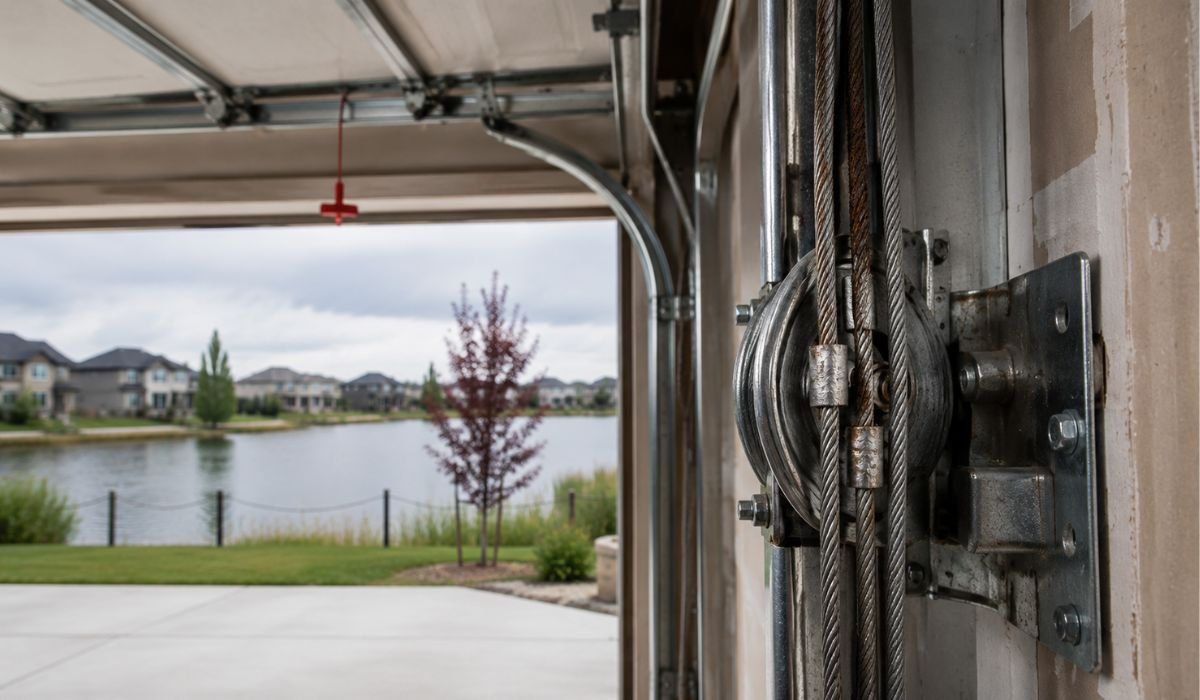
The garage door in a Mahogany home does not fail the way it does in a drier neighbourhood across the city. Park two identical houses side by side, one on the water in Auburn Bay and one on a dry ridge in the northwest, and after a decade the lakeside door will often show rust on its cables first. It is not bad luck, and it is not a coincidence. The lake that makes these communities so desirable is quietly working on the steel cables that hold your door up.
If you live in Auburn Bay, Mahogany, or nearby Cranston and Seton, this is worth understanding, because a corroded cable rarely announces itself until the morning it lets go. Here is what the humidity is actually doing, how to spot the warning signs early, and what keeps these cables lasting longer in a lake community. Cables are one piece of a bigger picture, so for how Calgary’s climate affects the whole door it is worth reading our complete Calgary garage door guide.
| Quick answer: why do lake-community homes see more cable problems?
Garage door lift cables are made of twisted steel. Steel rusts faster in humid air, and homes beside the Auburn Bay and Mahogany lakes sit in higher ambient humidity than inland Calgary neighbourhoods. Combine that moisture with winter road salt and Calgary’s constant freeze-thaw cycling, and the cables corrode and fray earlier, especially at the drum and the bottom bracket where the coating wears. Corroded cables can snap without warning, so early inspection matters more here than almost anywhere else in the city. |
Why do Auburn Bay and Mahogany homes have more garage door cable problems?
It comes down to where these communities are built: right on the water. Auburn Bay and Mahogany are two of Calgary’s largest lake communities, and living beside a body of water means living in higher local humidity. That moisture does not stay outside. Every time the garage door opens, humid air moves in and out, and in winter, snow and slush melt off vehicles and pool on the floor, adding even more moisture to the enclosed space. That standing moisture causes a second cold-weather problem in these communities, the bottom seal freezing to the concrete overnight.
Garage door cables are the steel lines that run down each side of the door, wind around a drum at the top, and work with the springs to carry the door’s weight. Steel and moisture do not get along. In a damp garage, bare or worn steel begins to oxidize, and once rust starts, it spreads along the cable and weakens the individual strands from the inside out.
Homes in these communities built through the 2000s and 2010s were often fitted with builder-grade hardware. Those cables are now old enough that the combination of age and humidity is starting to show, which is why cable calls cluster in these southeast neighbourhoods.
What does lake humidity actually do to a garage door cable?
Lift cables are usually galvanized, meaning they carry a thin zinc coating that resists rust. That coating is the cable’s main defence, and it does not last forever. Two spots wear first: the drum at the top, where the cable winds and unwinds thousands of times a year, and the bottom bracket, where the cable anchors to the door and sits closest to floor moisture, slush, and salt.
Once the coating wears through, humid air reaches bare steel and corrosion sets in. Rust does three things to a cable, all of them bad:
- It eats into the outer strands, so the cable loses thickness and strength where it can least afford to.
- It makes the strands brittle, so instead of flexing smoothly around the drum, they begin to crack and break one by one.
- It roughens the surface, which speeds up wear every time the cable moves against the drum and pulley.
A cable does not usually snap all at once. It frays strand by strand until the few remaining wires cannot hold the load, and then it goes. In a lake community, that timeline is compressed.
How does Calgary’s chinook cycle make cable corrosion worse?
Humidity sets the stage, and Calgary’s weather finishes the job. The city sees roughly 30 to 35 chinook events a year, each one swinging the temperature by 20 to 30 degrees in a matter of hours. For a garage cable, that means constant freeze and thaw. Moisture that condenses on the cold cable overnight thaws during a chinook, refreezes when the warmth passes, and repeats.
This freeze-thaw churn keeps moisture in contact with the steel far longer than a steady dry cold would, accelerating rust. It also flakes off protective coatings faster. Layer winter road salt on top, tracked in on tires and boots, and you have a genuinely corrosive environment inside a lakeside garage from November through March. Salt is one of the most aggressive rust accelerators there is, and it settles right at the bottom bracket where the cable is most vulnerable.
What are the warning signs of a corroding or fraying cable?
You can catch most cable failures before they happen if you know what to look at. Once a month, with the door closed, take a flashlight and check the cables running down each side. Watch for:
- Rust, orange staining, or dark discolouration anywhere along the cable, especially near the bottom bracket.
- Broken or splayed wire strands that stick out like a metal splinter. Do not run your hand along the cable to feel for these, since frayed steel is sharp.
- A cable that looks loose, slack, or has unwound unevenly from the drum at the top.
- A door that hangs crooked, sits higher on one side, or catches and jerks as it moves.
- New grinding, scraping, or popping sounds during opening and closing.
Any one of these is a reason to book an inspection. A cable showing rust and a few broken strands is living on borrowed time.
Is a frayed garage door cable dangerous?
Yes, and this is the part homeowners underestimate. Cables are under high tension because they share the job of holding up a door that can weigh well over a hundred kilograms. When a corroded cable snaps, the door can drop suddenly, lurch off track, or slam down. If a vehicle, a pet, or a person is underneath, that is a serious safety event, not just a broken part.
There is a second danger too. Cables work as a pair with the springs. When one cable fails, the entire load shifts onto the remaining cable and onto overstressed garage door springs, which are now more likely to be the next thing to go. This is why replacing a cable is not a do-it-yourself job. The components are under tension that can injure someone without the right tools and training. If you find a frayed cable, stop using the door and call a technician.
Can you prevent cable corrosion in a lake-community garage?
You cannot move the lake, but you can slow the corrosion down and add years to your cables. For Auburn Bay and Mahogany homeowners, a few habits make a real difference:
- Ventilate the garage. Let humid and salty air escape rather than sitting on the hardware. Cracking the door for a few minutes after parking a snow-covered vehicle helps moisture clear.
- Deal with meltwater. Do not let slush pool under the door for days. Squeegee it out or keep the floor clear so moisture is not constantly rising toward the cables.
- Wipe salt off the hardware in winter. A quick wipe of the bottom brackets and lower cable ends removes the most aggressive rust accelerator.
- Lubricate a few times a year. A proper garage door lubricant on the cables, rollers, and springs adds a moisture barrier and keeps everything moving smoothly. Avoid heavy grease that hardens in the cold.
- Ask for quality cables at replacement time. When cables are replaced, galvanized or coated cables rated for the load resist corrosion better than the cheapest builder-grade option.
Most importantly, book an annual inspection. A technician catches early corrosion, checks cable tension and spring balance, and replaces a worn cable on your schedule rather than on the coldest morning of the year.
If your community has an HOA, review the garage door rules in Calgary’s lake communities before any exterior work.
When should Auburn Bay and Mahogany homeowners call a technician?
Book a professional inspection or repair if you see any of the warning signs above, if your door is more than a few years old and has never had its cables checked, or if you hear new grinding or catching sounds. Call right away, and stop using the door, if a cable has visibly snapped, come off the drum, or if the door hangs crooked. A car trapped inside on a cold Calgary morning is an emergency.
| Local to Auburn Bay and Mahogany. We know these doors.
We service garage doors across Auburn Bay, Mahogany, Cranston, Seton, and the wider SE Calgary lake communities, and we see the humidity-driven cable wear these neighbourhoods are known for. Our technicians inspect cables and springs, replace worn hardware with corrosion-resistant parts, and quote in writing before any work begins, with no vague phone estimates that change on arrival. Call Fish Creek Garage Door Repair for a free cable and safety inspection, or book online and protect your door before the next chinook. |
Frequently Asked Questions
Why do garage door cables corrode faster in Auburn Bay and Mahogany?
Homes near the Auburn Bay and Mahogany lakes sit in higher ambient humidity than drier inland Calgary neighbourhoods. Steel garage door cables rust faster in moist air, especially where the galvanized coating has worn at the drum and the bottom bracket. Add road salt and repeated freeze-thaw cycles, and cables in these lake communities tend to show corrosion and fraying earlier.
What are the warning signs of a failing garage door cable?
Look for rust or discolouration on the cable, broken or fraying wire strands that look like a metal splinter, a cable that has come loose or unwound from the drum, a door that hangs crooked or catches on one side, and grinding or scraping sounds. Any of these means the cable should be inspected before it snaps.
Is a frayed garage door cable dangerous?
Yes. Garage door cables work under high tension alongside the springs to hold the weight of the door. A frayed or corroded cable can snap without warning, causing the door to drop suddenly or hang off track. Replacing cables involves handling tensioned components safely, so it is a job for a trained technician rather than a do-it-yourself repair.
Can I prevent garage door cable corrosion in a lake-community home?
You can slow it down. Keep the garage ventilated so humidity and melting snow do not sit in the air, wipe road salt off the door hardware in winter, apply a proper garage door lubricant to the cables and moving parts a few times a year, and ask for galvanized or coated cables when replacements are needed. An annual inspection catches early corrosion before it becomes a failure.
How long do garage door cables last in Calgary’s climate?
In average conditions garage door cables can last many years, but in humid lake communities like Auburn Bay and Mahogany, combined with road salt and chinook freeze-thaw cycling, corrosion can shorten that lifespan noticeably. Many builder-grade cables in homes built during the 2000s and 2010s are now reaching the age where inspection is worthwhile.
My garage door cable snapped. What should I do right now?
Stop using the door and do not try to force it open or closed. A snapped cable throws the door out of balance and puts extra load on the remaining cable and springs, which can fail next. Leave the door in place and call a garage door technician. In cold weather with a car trapped inside, treat it as an emergency.
