
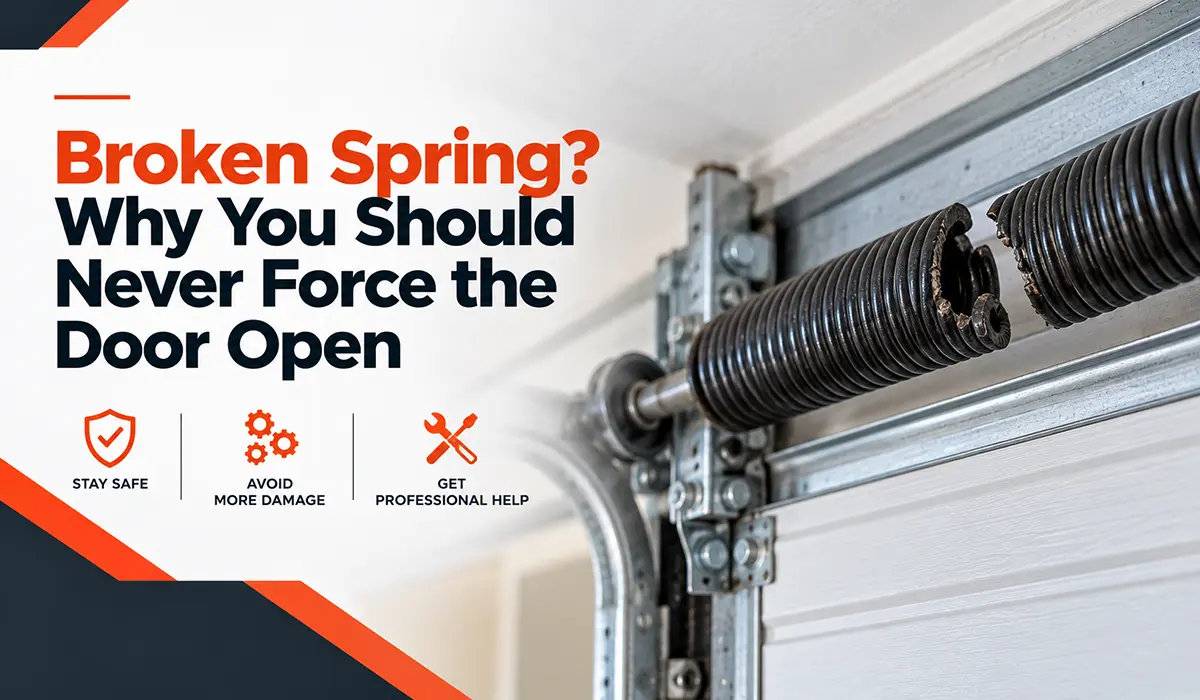
If your garage door spring is broken, do not try to force the door open. The spring is what carries the weight of the door, which is usually between 100 and 250 pounds. Without it, that full weight sits on your hands, your opener and a set of cables that were never meant to hold it alone. The door can drop, pinch or crush, and the opener can burn out in a single attempt. The safe move is to stop, keep people and vehicles clear, and call a professional.
This guide explains how to tell if a spring has broken, why forcing the door is risky, what to do right now, and what a spring repair costs in Calgary.
What a Garage Door Spring Actually Does
Most people think the opener lifts the garage door. It does not. The spring does most of the work.
The spring stores energy when the door is closed and releases it as the door goes up. That energy balances the door so it feels almost weightless. The opener only guides the door along the track and keeps it moving. When the spring works, a 200-pound door can be lifted with one hand.
Most homes have one of two types:
- Torsion springs. These sit on a metal bar above the door. They twist to store energy. They are the most common type on modern homes.
- Extension springs. These run along both sides of the door, parallel to the tracks. They stretch to store energy.
Both types hold a large amount of tension, which is why a break is loud and why the repair is not a DIY job.
How to Tell If Your Garage Door Spring Is Broken
Look and listen for these signs:
- A loud bang from the garage. Many homeowners describe it as a gunshot or a firecracker. It often happens when the door is closed.
- The door will not open. The opener hums or strains, then stops. Or the door lifts a few inches and drops.
- The door feels very heavy when you try to lift it by hand.
- A visible gap in the spring. On a torsion spring, you may see a split of about 5 cm (2 in) or more in the coil.
- Loose or slack cables. A broken torsion spring often leaves the lifting cables hanging.
- The door looks crooked or uneven as it moves.
- An extension spring hanging or snapped at the side of the door.
If you see any of these, the safest assumption is that the spring has failed.
Why You Should Never Force the Door Open
It is tempting to grab the handle and push, or to hit the opener button again and again. Both are bad ideas. Here is why.
1. The door can fall on you
Without a working spring, you are holding the full weight of the door. If your grip slips, if a cable lets go or if a roller jumps the track, the door can come down fast. This is how people suffer crushed fingers, hand injuries and worse.
2. The cables are under stress
On a torsion system, the cables rely on the spring to share the load. When the spring breaks, the cables can slip off the drums or snap if the door is forced. A loose cable can whip around and cause injury.
3. You can burn out the opener
Garage door openers are built to guide a balanced door. They are not designed to lift 200 pounds of dead weight. Pressing the button on a door with a broken spring can strip the gears, burn the motor or damage the drive. A repair that would have cost one amount becomes a repair plus a new opener.
4. The door can come off the track
Forcing a door that is out of balance can bend the track, twist the panels or pop a roller out. The door can then jam halfway, which is harder and more expensive to fix.
5. The repair gets bigger
A broken spring is usually a simple job. A forced door often turns it into a spring repair, a cable repair, a track repair and sometimes a new door. Each attempt adds damage.
6. The spring may still hold stored energy
On a torsion system, one spring may break while the other remains under tension. Tools slip, bars fly and fingers get hurt. Professionals use winding bars and a set procedure for a reason.
What To Do Right Now
What you do depends on where the door is.
If the door is closed:
- Stop pressing the opener button.
- Keep kids, pets and vehicles away from the door.
- If you must disconnect the opener, pull the red emergency release cord with the door fully closed. Do not lift the door.
- Call a professional.
If the door is partly open or fully open:
- Do not pull the red release cord. The door may drop fast without the opener holding it.
- Do not stand or walk under the door.
- Keep people and vehicles clear.
- Call a professional.
If your vehicle is inside the garage:
Do not try to lift the door yourself to get out. Call us and explain the situation so we can book the first available visit.
What Not To Do
- Do not keep pressing the opener button. It can damage the motor and gears.
- Do not lift the door by hand to “see if it works.” A door with a broken spring is much heavier than it looks.
- Do not touch the springs, the cables or the brackets at the bottom corners. They hold high tension.
- Do not put fingers between the panels. If the door moves, the joints can pinch.
- Do not prop the door open with a ladder, a stick or your car. It can slip.
- Do not try to wind a new spring using screwdrivers or tools from a hardware store. Winding bars are made for this job, and the wrong tool can fly out under load.
- Do not leave a half-open door for the night. It is a safety risk and a security risk.
Why Garage Door Springs Break
Springs do not last forever. They are a wear part, like tires or brake pads.
Cycle life. A standard spring is rated for about 10,000 cycles. One cycle is one open and one close. A family using the door four times a day uses about 1,460 cycles a year, so a standard spring lasts about seven years. High-cycle springs are rated for more, often 25,000 cycles or higher.
Cold weather. Calgary’s cold snaps and chinook swings put stress on metal. Springs often fail on the coldest mornings of the year, when the metal is stiffest.
Rust and lack of lubrication. Moisture, road salt and dry coils create friction and wear.
Poor balance. A heavy door, a new insulated panel or a door that was never balanced puts extra load on the spring.
Age. If one spring breaks, the other is usually the same age and near the end of its life.
Signs a spring is about to fail
You may get a warning before it breaks:
- The door feels heavier than it used to
- The door moves in a jerky or uneven way
- The opener strains or sounds louder
- You can see rust on the coil
- The door sags or looks crooked when open
- The springs are more than seven years old and have never been inspected
Torsion vs. Extension Springs
| Torsion spring | Extension spring | |
|---|---|---|
| Location | On a bar above the door | Along the sides of the door |
| How it works | Twists to store energy | Stretches to store energy |
| Lifespan | Usually longer | Usually shorter |
| When it breaks | Loud bang, door will not lift | Spring or cable can whip around |
| Safety notes | Never touch the winding cones | Should have safety cables through the spring |
| Calgary advice | Replace springs in pairs | Check for safety cables, replace both sides |
If your home has extension springs, ask us about safety cables. They stop a broken spring from flying across the garage.
What a Professional Spring Repair Involves
Here is what happens during a typical visit:
- Inspection. We check the door, the cables, the drums, the rollers, the tracks and the opener to see if anything else is damaged.
- Door secured. We lock the door in place before touching the spring.
- Old springs removed. We release the remaining tension with proper winding bars.
- New springs fitted. We choose springs that match the weight, height and size of your door. The wrong spring size makes the door unbalanced.
- Winding and balance. We wind the springs to the right tension and test the balance by hand.
- Checks and lubrication. We lubricate moving parts, check the cables and rollers, and test the safety reversal on the opener.
- Walkthrough. We explain what we found and what to watch for.
Most spring repairs take around one hour for a standard door, but it depends on what else needs attention.
How Much Does Garage Door Spring Repair Cost in Calgary?
Spring replacement starts at $349 plus 5% GST at Fish Creek Garage Door Repair Calgary. The final price depends on your door.
What affects the price:
- Door size and weight. Double doors and heavy insulated doors need stronger springs.
- One spring or a pair. We recommend replacing both on a two-spring system.
- Spring type. High-cycle springs cost more but last much longer.
- Other damage. Cables, rollers, drums and bearings may need replacing at the same visit. Cable, roller and seal work starts from $199.
- Upgrades. Some homeowners switch to a different spring system for better balance and longer life.
We give you a written price before we start. There is no weekend surcharge.
Springs are cheaper than the damage that comes from forcing the door. A spring repair is a fraction of the price of a new opener, a new set of panels or an injury.
Can You Wait a Few Days to Fix a Broken Spring?
We do not recommend it. A door with a broken spring cannot be used safely. If you leave it:
- Your vehicle may be stuck inside, or your garage may be left open and exposed
- Someone may try to force the door and get hurt
- The cables can loosen further and slip off the drums
- Kids and pets may be near a door that cannot be used safely
If the door is closed and the opener is disconnected, the garage is not a danger as long as nobody tries to use it. Book the repair as soon as you can.
How To Make Your Next Spring Last Longer
- Book a yearly garage door tune-up. We check the balance, lubricate the coils and look for rust or wear.
- Ask about high-cycle springs. If your family uses the door many times a day, higher-rated springs are worth the extra cost.
- Test the balance twice a year. With the door closed, pull the red cord and lift the door to waist height. If it stays put, the balance is good. If it drops or flies up, call us. We explain this test in our guide on when to replace a garage door opener.
- Fix small problems early. A frayed cable, a worn roller or a noisy door adds load to the spring.
- Keep the bottom seal in good shape. A worn or frozen seal makes the door and opener work harder in winter.
Garage Door Spring Repair Across Calgary
We repair springs in the south and southeast of Calgary and nearby communities:
- Shawnessy
- Bridlewood
- Cranston
- Evergreen
- McKenzie Towne
- Auburn Bay
- Legacy
- Aspen Woods
- Mahogany
- New Brighton
- Seton
- Walden
Frequently Asked Questions
Can you open a garage door with a broken spring?
You can, but you should not. A door with a broken spring weighs 100 to 250 pounds with nothing to support it. Lifting it by hand risks injury, and using the opener can burn out the motor. Disconnect the opener only if the door is closed, and call a professional.
How do I know if my garage door spring is broken?
Common signs are a loud bang from the garage, a door that will not lift or feels very heavy, a visible gap in the spring coil, and loose cables. If the opener hums but the door barely moves, the spring is the most likely cause.
How much does it cost to replace a garage door spring in Calgary?
Spring replacement starts at $349 plus 5% GST at Fish Creek Garage Door Repair Calgary. The final price depends on the door size, the spring type and whether cables or rollers also need work. We give you a written price before we begin.
Should I replace one spring or both?
Replace both on a two-spring system. Springs wear at the same rate, so when one breaks, the other is usually close behind. Replacing both keeps the door balanced and saves you a second visit and a second bill.
How long do garage door springs last?
A standard spring lasts about 10,000 cycles, which is around seven years for a family opening the door four times a day. High-cycle springs can last 25,000 cycles or more. Cold weather, rust and an unbalanced door can shorten the life.
Is it safe to fix a garage door spring myself?
No. Garage door springs hold enough tension to cause serious injury. Winding bars, correct spring sizing and a set procedure are needed. Most manufacturers and professionals advise against DIY spring work. We do this job every week and know how to do it safely.
Will a broken spring damage my garage door opener?
It can. The opener is built to guide a balanced door, not lift its full weight. Repeated button presses can strip gears and burn out the motor. Stop using the opener as soon as you suspect a broken spring.
Need a Broken Spring Fixed in Calgary?
Call us, tell us what you heard and saw, and we will book the first available visit. We will check the whole door, give you a clear written price and fix it right the first time.
Fish Creek Garage Door Repair Calgary #280, 23 Sunpark Drive S.E., Calgary, AB T2X 3V1 Phone: +1 587 893 3737 Email: fishcreekgaragedoor@gmail.com
