
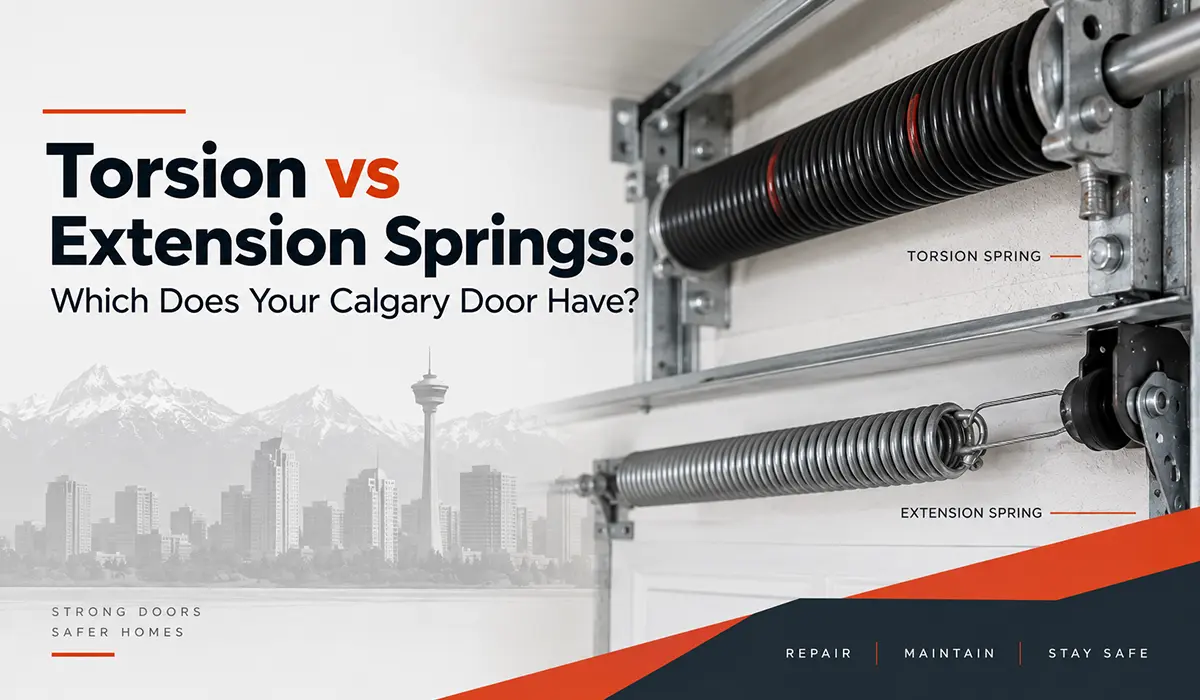
The fastest way to tell which springs your Calgary garage door has is to look above the door while it is closed. If you see one or two springs wound tightly around a metal shaft that runs sideways across the wall above the opening, you have torsion springs. If instead you see a long spring stretched along each side, sitting above the horizontal tracks that run back toward the ceiling, you have extension springs. Most newer Calgary doors use torsion springs, and for our winters, that is the better system.
Springs are the single most common part we replace on Calgary garage doors, and the calls spike every time the temperature drops. This guide shows you how to identify your spring type in under a minute, explains how torsion and extension springs differ, and covers why our cold has so much to do with how long they last.
One safety note first. Garage door springs hold an enormous amount of tension. It is fine to look at them, but never touch, adjust, or try to replace them yourself. That work is for a trained technician.
How to tell which spring type you have
Close your garage door, then stand inside and look up. You are checking two spots.
Torsion springs sit above the door
Look at the wall directly above the closed door. Torsion springs mount on a metal shaft, sometimes called a torsion tube, that runs horizontally across the top of the opening. A single-car door usually has one spring, and a wider double door often has two. When the door moves, the shaft turns and winds cables onto drums at each end to lift the weight. If you see a spring on a bar above the door, you have torsion.
Extension springs run along the tracks
Now look to the sides and up toward the ceiling. Extension springs are long, and there is one on each side, mounted above and parallel to the horizontal tracks that run from the top of the door back into the garage. They stretch when the door closes and contract when it opens. If your springs are on the sides rather than on a shaft above the door, you have extension springs.
If you have extension springs, check for safety cables. A cable should run through the middle of each spring and anchor at both ends. That cable keeps a broken spring from flying across the garage. If your extension springs do not have safety cables, have them added right away.
Quick comparison: torsion vs extension springs
Here is how the two systems compare on what matters most for a Calgary home.
| Feature | Torsion springs | Extension springs |
|---|---|---|
| Where they are | On a shaft above the door, centered | One on each side, above the tracks |
| How they work | Twist to store energy | Stretch and contract |
| Typical lifespan | 15,000 to 20,000 cycles (10 to 15 years) | About 10,000 cycles (5 to 7 years) |
| If it breaks | Stays on the shaft, safer | Can fly loose without safety cables |
| Noise | Quieter, smoother | Louder, jerkier |
| Upfront cost | Higher | Lower |
| Headroom needed | About 12 inches above the door | Works with limited headroom |
| Best for | Heavy or insulated doors, most modern doors | Older or low-headroom garages |
Torsion springs explained
Torsion springs do their work by twisting. As the door closes, the spring winds up and stores energy. As the door opens, it unwinds and releases that energy to lift the door in a smooth, controlled motion. Because the spring is mounted on a fixed shaft, it balances the door evenly and puts less strain on the opener.
Where they win
- Longer lifespan, usually 15,000 to 20,000 cycles, which is roughly 10 to 15 years of average use.
- Smoother and quieter operation, which matters for attached garages near living space.
- Safer when they fail, because a broken torsion spring stays on the shaft instead of springing loose.
- Better at balancing heavy and insulated doors, which are common in Calgary for the extra warmth.
The trade-offs
- Higher upfront cost than extension springs.
- Need about 12 inches of headroom above the door for the shaft, so a very low garage ceiling can be a limit.
Extension springs explained
Extension springs work by stretching. When the door closes, the springs extend and load up with energy. When the door opens, they contract and pull the door up through a system of pulleys and cables. They are an older design and are still common on budget builds and garages with limited headroom, since they do not need a shaft above the door.
Where they win
- Lower upfront cost.
- Fit garages with limited headroom, since they mount along the sides.
- Simple design that makes wear easier to spot.
The trade-offs
- Shorter lifespan, usually around 10,000 cycles, or about 5 to 7 years.
- Must have safety cables. Without them, a snapped spring can launch across the garage and cause injury or damage.
- Noisier and jerkier, because they do not spread the load as evenly as torsion springs.
- Less suited to heavy or insulated doors.
Why springs are the number one winter failure in Calgary
Ten years of Calgary service calls point to one clear pattern. When the cold arrives, the phone rings about springs. Here is the reason behind it.
Garage door springs are made of high-tensile carbon steel and sit under constant tension from the day they are installed. Every time the door opens and closes counts as one cycle, and over thousands of cycles, tiny cracks form inside the metal. That slow wear is called metal fatigue, and it happens to every spring eventually.
Cold weather speeds the failure up. When the temperature drops, steel contracts and becomes more brittle and less flexible. That contraction actually raises the tension inside the coils, even with the door closed. A spring that was already near the end of its life gets pushed past its breaking point, and it snaps. That loud bang homeowners hear from the garage on a January morning is usually a spring letting go.
Calgary adds two problems most cities do not have. Our cold snaps push past -30 C, which is exactly when brittle steel is most likely to fracture. On top of that, chinook winds swing the temperature by twenty degrees or more in a matter of hours, warming and cooling the steel over and over. That repeated expand-and-contract cycle stacks extra stress on metal that is already fatigued. Add the weight of snow and ice on the door and lubricants that stiffen in the cold, and it is no surprise that spring failures spike after the first hard freeze.
Torsion springs handle all of this better than extension springs, which is a big part of why they have become the standard on modern doors.
Which spring is right for a Calgary door?
For most Calgary homes, torsion is the better long-term choice. It lasts longer, runs smoother, fails more safely, and balances the heavier insulated doors that make sense in our climate. Extension springs still have a place on older garages and low-ceiling builds where headroom is tight.
Thinking about an upgrade? If you currently have extension springs, you can usually convert to torsion, as long as you have about 12 inches of headroom above the door for the shaft. The conversion improves lifespan, safety, and how evenly the door moves. If headroom is limited, good-quality extension springs with proper safety cables remain a solid option.
Signs your spring is failing
Catching a worn spring before it snaps saves you from being stuck with a door that will not move. Watch for these.
- A loud bang from the garage, often the first and clearest sign.
- The door suddenly feels very heavy, or the opener strains and gives up partway.
- A visible gap of about two inches in a torsion spring coil, which means it has broken.
- The door opens crooked, or one side sags lower than the other.
- Loose or hanging cables next to the door.
- Jerky, uneven movement where the door used to run smoothly.
If you notice any of these, stop using the door. Do not try to force it open with the opener or by hand, and do not attempt to adjust or replace the spring yourself. A door with a broken spring can cause injury and further damage. Call a technician to handle it safely.
How to make your springs last through a Calgary winter
You cannot stop springs from wearing out, but you can slow it down and avoid a mid-winter surprise. These steps make the biggest difference here.
- Lubricate the right way: Two or three times a year, apply a proper garage door lubricant to the springs, rollers, and hinges. Use a lithium or silicone-based product, not WD-40, which attracts grime. This keeps parts moving freely in the cold.
- Keep the door balanced: Disconnect the opener and lift the door halfway by hand. A balanced door stays put. If it slams down or flies up, the springs are off and straining the whole system, so book a service.
- Insulate the space: An insulated door and garage hold more warmth, and warmer springs stay less brittle and last longer.
- Upgrade to high-cycle springs: When it is time to replace, ask about high-cycle springs. They use thicker wire and more coils and last well beyond the standard rating, which pays off in a climate like ours.
- Book a pre-winter tune-up: A tune-up in the fall catches worn springs and dry parts before the first cold snap does the job for you.
Frequently asked questions
How do I know if I have torsion or extension springs?
Look above your closed garage door. If you see one or two springs wound around a metal shaft running horizontally across the wall above the door, you have torsion springs. If you see a long spring stretched along each side, above the horizontal tracks, you have extension springs. Only look, never touch or adjust them.
Which is better, torsion or extension springs?
For most homes, torsion springs are the better choice. They last longer, run smoother and quieter, balance heavy or insulated doors better, and are safer because they stay on the shaft if they break. Extension springs cost less upfront and suit low-headroom garages, but they need safety cables and wear out sooner.
Why do garage door springs break in winter in Calgary?
Springs are high-tensile steel under constant tension. Cold makes the steel contract and turn brittle, which raises internal stress and reduces flexibility. A spring already near the end of its life often snaps under that added stress, which is the loud bang people hear from the garage in January. Calgary chinook swings add repeated expand-and-contract stress, so failures spike after the first hard freeze.
How long do garage door springs last?
Springs are rated in cycles, where one cycle is opening and closing once. Torsion springs typically last 15,000 to 20,000 cycles, or roughly 10 to 15 years with average use. Extension springs last around 10,000 cycles, or about 5 to 7 years. Heavy use and cold winters shorten both.
Can I replace a garage door spring myself?
It is not recommended. Garage door springs hold enough tension to cause serious injury if they release suddenly. Spring replacement should be handled by a trained technician with the right tools. If your spring is broken, do not try to force the door open, as this can damage the opener and cables.
Can I convert extension springs to torsion springs?
In most cases, yes. Converting to torsion improves lifespan, safety, and balance, and it usually needs about 12 inches of headroom above the door for the torsion tube. If headroom is tight, high-quality extension springs with proper safety cables are still a good option.
How much does garage door spring replacement cost in Calgary?
The cost depends on the spring type, the size and weight of your door, and whether one or both springs are replaced. We recommend replacing springs in pairs so the door stays balanced. We provide a clear written quote before any work begins, so you know the full cost upfront. Call us for a free estimate.
Broken spring or a door that will not open in Calgary?
Fish Creek Garage Door Repair Calgary replaces torsion and extension springs safely, with same-day service and honest, upfront pricing. We always replace springs the right way, check your door balance, and can upgrade you to longer-lasting high-cycle springs built for our winters. Never risk a spring on your own. Let our certified local technicians handle it.
Call +1 587 893 3737 for a free, no-obligation quote, or email fishcreekgaragedoor@gmail.com. We serve Fish Creek, Cranston, Auburn Bay, Evergreen, Shawnessy, Mahogany, and every Calgary neighbourhood.
