
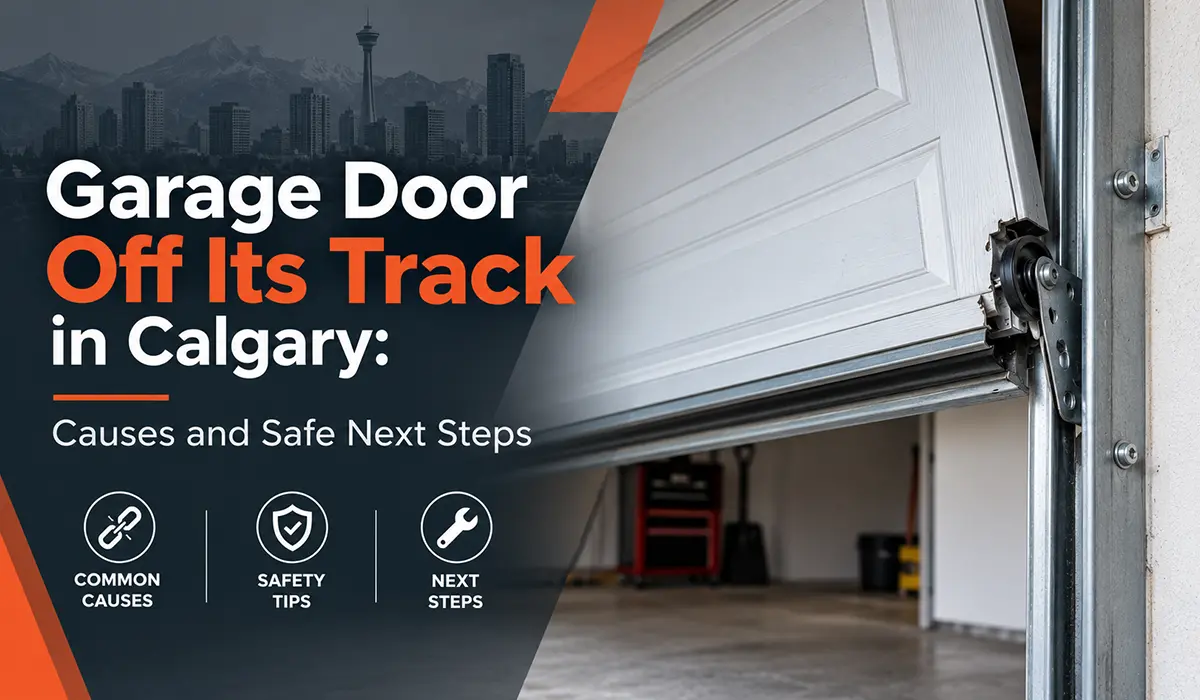
If your garage door has come off its track, here is the short version. Stop using it right away, keep everyone and every vehicle clear of it, and call a professional. An off-track door is one of the most dangerous garage door problems there is. A residential door weighs well over 100 pounds, and a large insulated double door can weigh 300 pounds or more. Once the rollers leave the track, that weight is hanging at an angle with nothing holding it in its proper path, and it can fall without warning.
Calgary winters make this failure more common than it is in milder cities, mostly because of ice, packed snow, and doors that freeze to the concrete. This guide walks you through how to tell your door is off track, the safe steps to take right now, what causes it, and why the fix belongs to a trained technician.
How to tell your door is off track
You are usually looking at one or more of these.
- The door is crooked, leaning, or wedged at an angle in the opening.
- One or more rollers are sitting outside the track or dangling from a hinge.
- The door binds, grinds, or stops partway and will not move.
- You heard a loud bang, and now the door is hanging oddly.
- A cable has gone slack, snapped, or unwound from its drum.
Safe next steps to take right now
Work through these in order. The goal is to keep everyone safe and avoid turning a repair into a bigger one.
- Stop pressing the opener. Every extra push can bend the track further, damage the door, or snap a cable.
- Clear the area. Move vehicles out from under the door if you can do it safely, and keep children and pets well away from the opening.
- Cut power to the opener. Unplug it at the ceiling outlet or switch off its breaker so no one runs it by accident. If the door is stuck partway open, do not pull the manual release cord. An off-track door is unbalanced and can drop hard. If the door is safely closed, you have more room, but still leave the springs and cables alone.
- Do not touch the springs or cables. They hold extreme tension and are a common reason the door came off track in the first place.
- If the door is stuck open, Treat it as a security issue and call for emergency service to secure your home.
- Call a technician. Mention anything you saw, such as a snapped cable or a spring with a visible gap, so they arrive ready to fix it.
What to do and what to avoid
A quick reference while you wait for help.
| Do this | Avoid this |
|---|---|
| Stop using the door and keep everyone clear | Pressing the opener again to force it up or down |
| Cut power to the opener so it cannot run | Lifting or prying the door by hand |
| Note any snapped cable or broken spring | Pulling the release cord on a partly open door |
| Call for same-day or emergency service | Touching or adjusting the springs and cables |
| Secure the garage if the door is stuck open | Disabling the safety reverse to make it close |
Common causes of an off-track garage door
A garage door runs on a system of rollers, tracks, cables, and springs. When one part fails or slips, the whole door can go out of alignment. These are the usual culprits.
- Worn or broken rollers: Rollers crack or wear down over time and lose their grip on the track.
- Broken or frayed cable: If a lift cable snaps or frays, the door drops on one side and pulls the rollers out of line.
- Broken spring: A broken spring leaves the door unbalanced, which puts uneven stress on everything else.
- Vehicle impact: A car bump, even a slow one, can bend a track or knock rollers loose.
- Something in the track: Debris, a stray tool, or a build-up of ice in the channel can stop a roller and push it out of the track.
- Hitting an object on the way down: If the door hits an obstruction while closing, the opener keeps pushing, which can twist the door and pop the rollers.
- Loose hardware: Years of vibration can loosen the bolts on the track brackets. A track that shifts even half an inch can let rollers slip.
Why Calgary winters knock doors off track
Across a Calgary winter, we get more off-track calls than in any other season, and the reasons trace straight back to our weather.
- Ice in the tracks: Melt water from chinooks and afternoon sun runs into the tracks and refreezes overnight. A chunk of ice in the channel stops a roller cold and forces it out on the next open.
- Doors frozen to the concrete: The bottom seal can freeze to the slab overnight. In the morning the opener pushes hard against a door that will not budge, and that strain can twist the door, pop the rollers, or snap a cable.
- Packed snow and grit: Snow, road salt, and sand get tracked into the garage and build up in the lower tracks, where they jam the rollers.
- Stiff, brittle parts: Deep cold makes rollers and hardware more brittle and thickens old lubricant, so rollers bind instead of rolling. A bound roller is a roller about to jump the track.
- Extra weight: Snow and ice add weight to the door, which loads the springs and cables harder. When one of those fails, the door can come off track.
The pattern we see most is a door that was already a little worn heading into winter, and then the first hard freeze or a frozen bottom seal finishes the job.
Why off-track repair is a job for a technician
An off-track door is under unpredictable tension. The springs, cables, and the door’s own weight are no longer sitting in their designed path, so any move you make shifts the load in ways that are hard to predict. That is why this is not a pry-bar-and-pliers job.
When a technician arrives, they secure the door’s weight with locking pliers and clamps so it cannot fall, then safely release and manage the spring tension. From there they inspect and replace any damaged rollers, cables, or bent track, realign the door, rebalance it, and test it. If a broken cable or spring caused the problem, that gets repaired at the same time. Skip that step and the door will simply jump the track again the first time you use it.
How to prevent it next winter
Most off-track failures give warning signs, and most are preventable with a little upkeep. These are the ones that matter most here.
- Keep the tracks clear: Check the tracks and the base of the door after storms and clear out ice, packed snow, and debris before they build up.
- Stop the door freezing down: Keep the bottom seal in good shape, clear snow from the threshold, and never force a frozen door. If it will not open, let it thaw or call for help.
- Lubricate the right way: Two or three times a year, treat the rollers, hinges, and springs with a garage door lubricant that works in the cold, not WD-40.
- Replace worn rollers early: Cracked or wobbly rollers are a common starting point for an off-track door, so swap them before they fail.
- Act on warning signs: Grinding, jerky movement, or a door that hangs slightly crooked means something is going. Book a service before it lets go.
- Book a pre-winter tune-up: A tune-up in the fall catches worn parts before the cold does the job for you.
Frequently asked questions
Is it safe to use a garage door that is off track?
No. An off-track door is unstable and can fall without warning. It weighs well over 100 pounds, and a large insulated double door can be 300 pounds or more, hanging at an angle with the rollers out of the track. Stop using it, keep people and vehicles clear, and call a professional.
What should I do first if my garage door is off track?
Stop pressing the opener, since every push can bend the track or snap a cable. Keep the area clear of people, pets, and vehicles. Cut power to the opener so no one operates it by accident. Do not touch the springs or cables, and do not force the door. Then call a garage door technician for same-day or emergency service.
Can I fix an off-track garage door myself?
It is not recommended. An off-track door is under unpredictable spring and cable tension, and any move you make shifts that load in ways that are hard to predict. Technicians use locking pliers and clamps to secure the door weight and safely manage spring tension before realigning it. Forcing it back yourself risks injury and more damage.
Can ice cause a garage door to come off track?
Yes. Ice is one of the most common winter causes in Calgary. Melt water can run into the tracks and refreeze, and a chunk of ice in the channel blocks a roller and forces it out of the track. A door frozen to the concrete also strains the opener, which can twist the door and pop the rollers loose.
How do I stop my garage door from freezing to the concrete?
Keep the bottom seal in good condition, clear snow and ice from the threshold before it packs down, and never force a door that has frozen down. Let it thaw or call for help. Keeping the tracks free of ice and lubricating the moving parts with a cold-rated garage door lubricant also helps the door move freely in winter.
How much does off-track garage door repair cost in Calgary?
The cost depends on what caused it and what needs to be replaced, such as rollers, a cable, a spring, or a section of bent track. Simple realignments cost less than repairs that involve broken hardware. We provide a clear written quote before any work begins, and we offer same-day and emergency service. Call us for a free estimate.
Garage door off its track right now?
Do not risk an off-track door. Fish Creek Garage Door Repair Calgary offers same-day and emergency service across the city, with certified local technicians who safely secure the door, replace worn rollers, cables, or springs, realign the track, and rebalance everything so it stays put. We give you a clear written quote before any work begins.
Call +1 587 893 3737 now for fast help, or email fishcreekgaragedoor@gmail.com. We serve Fish Creek, Cranston, Auburn Bay, Evergreen, Shawnessy, Mahogany, and every Calgary neighbourhood.
