
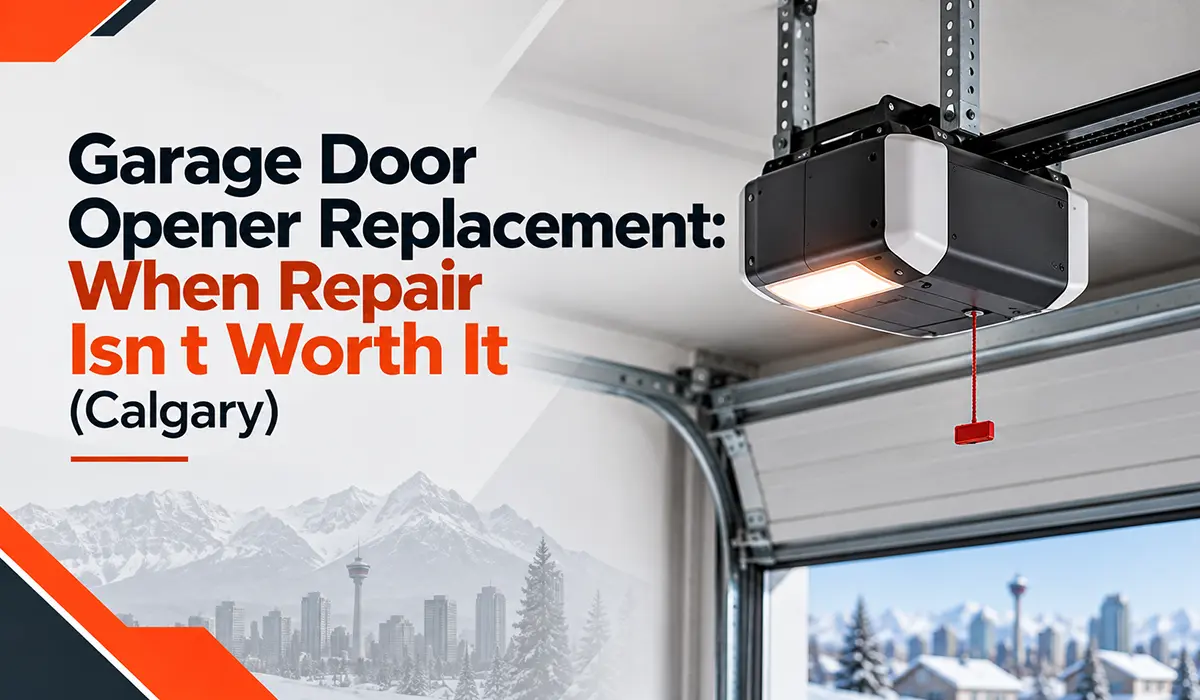
If your garage door opener is more than 12 years old, keeps breaking down, or needs a repair that costs about half the price of a new unit, replacing it is usually the smarter move. A newer opener is quieter, safer and handles Calgary winters better, and it comes with a fresh warranty. If your opener is under 10 years old and the problem is a sensor, a remote or a worn gear, repair is almost always the better value.
This guide explains how to tell the difference, what each option costs in Calgary, and one simple check that can save you from buying an opener you did not need.
How Long Does a Garage Door Opener Last?
Most home openers last 10 to 15 years. The real number depends on how often you use the door and whether the door itself is in good shape.
A family that opens and closes the door six to eight times a day puts about 2,000 to 3,000 cycles a year on the motor. Over ten years, that is more than 20,000 cycles. Parts wear out, gears lose their teeth and circuit boards fail. It is normal, and it is the main reason age matters so much when you decide between repair and replacement.
If you do not know how old your opener is, check the label on the motor housing. Most labels list a manufacture date or a serial number you can look up.
The 50% Rule: A Simple Way to Decide
Here is the rule we use with Calgary homeowners. If a repair costs half or more of a new, installed opener, replace it.
Here is how that looks with real numbers:
- An opener repair at our shop starts at $249. A new opener starts at $749. That means a basic repair sits at about one third of the cost of a new unit.
- If a quote for a repair reaches about $375, you have hit the 50% line. At that point you are paying for a big part of a new opener and still keeping an old motor.
- Age shifts the math. A $249 repair on a 4-year-old opener is good value. The same $249 repair on a 14-year-old opener often buys you a few more months before the next failure.
All prices are plus 5% GST. We give you the full price before we start any work.
Check the Door Before You Blame the Opener
This is the step many homeowners skip. A heavy or unbalanced door is one of the most common reasons an opener struggles, burns out or strips its gears early. If the springs are worn, the opener ends up lifting the full weight of the door. It was never built to do that.
You can check balance in about two minutes:
- Close the door fully.
- Pull the red emergency release cord so the door disconnects from the opener.
- Lift the door by hand to about waist height and let go.
- A balanced door stays where it is or drifts slowly. A door that crashes down or flies up has a spring problem.
If the door fails this test, do not buy a new opener yet. A new opener on a bad spring will wear out fast. Fix the spring first.
Please do not touch the springs, the cables or the brackets at the bottom corners of the door. They hold a large amount of tension and can cause serious injury. Our team handles garage door spring repair and garage door cable repair every week in Calgary, and we will tell you honestly if the opener is fine and the spring is the real problem.
Signs Repair Is Still Worth It
Repair makes sense when the problem is small and the opener is fairly young. These are the usual cases:
- The remote or keypad stopped working. Often it is a dead battery or a programming issue.
- The door reverses before it closes. This is usually a misaligned or dirty safety sensor.
- The door stops partway or does not fully open. The travel limits may need to be reset.
- The light does not turn on. A bulb or a wiring connection is a cheap fix.
- The motor hums but the door does not move. A worn drive gear or sprocket can often be replaced.
- The opener is under 10 years old and has no history of repeated problems.
If this sounds like your situation, see our garage door opener repair service. Many of these jobs take under an hour.
Signs Replacement Is the Better Move
Replace the opener when repairs are no longer a good use of your money. These are the red flags:
- It is 12 to 15 years old, or older. Parts get harder to find and the next failure is usually close.
- You have paid for two or more repairs in the last 12 to 18 months. The repairs are adding up to the price of a new unit.
- The circuit board or motor has failed. On an older opener, this repair often costs more than it is worth.
- It has no photo-eye safety sensors. Older openers, especially ones made before the early 1990s, may not have them. Safety sensors stop the door from closing on a child, a pet or a car bumper.
- It uses a fixed code remote. Older systems with dip switches are easier to copy than modern rolling code systems. A new opener gives you better security for your home and anything stored in the garage.
- It is very loud. Old chain drives can rattle the whole house, especially when a bedroom sits above the garage.
- It cannot lift your door anymore. If you have added an insulated door or a heavier door since the opener was installed, the motor may be undersized.
- It does not have battery backup. Calgary has its share of winter power outages, and a battery backup lets you get your car out without pulling the manual release.
Repair vs. Replace: Quick Comparison
| Problem | Opener age | Our usual advice |
|---|---|---|
| Dead remote or keypad | Any | Repair |
| Misaligned safety sensor | Any | Repair |
| Door stops or reverses at a certain point | Under 12 years | Repair (adjust limits and force) |
| Worn drive gear or sprocket | Under 10 years | Repair |
| Worn drive gear or sprocket | Over 12 years | Replace in most cases |
| Failed circuit board | Under 8 years | Repair |
| Failed circuit board | Over 10 years | Replace |
| Burned-out motor | Any | Replace |
| Very loud, jerky or slow | Over 12 years | Replace |
| No safety sensors or fixed code remote | Any | Replace |
| Door is heavy or springs are worn | Any | Fix the springs first, then reassess |
What Does Garage Door Opener Replacement Cost in Calgary?
A new garage door opener starts at $749 plus 5% GST at Fish Creek Garage Door Repair Calgary. The final price depends on the model and a few other things.
What changes the price:
- Drive type. Chain drives cost the least. Belt drives and wall-mount openers cost more.
- Motor power. Most single and double doors work well with a standard motor. Heavy insulated doors or very large doors may need more power.
- Features. Wi-Fi control, battery backup, cameras and built-in lighting add to the price.
- Your garage setup. High ceilings, a door with extra lift or a unit that has to be moved can add parts or labour.
- Removal of the old opener. Ask every company if disposal is included in their quote.
When you compare quotes, ask what is included. A good quote lists the opener model, the wall control, the safety sensors, the remotes, the installation, the old unit removal and the warranty.
Which Type of Opener Should You Choose?
| Drive type | Noise | Cost | Best for |
|---|---|---|---|
| Chain drive | Loudest | Lowest | Detached garages and tight budgets |
| Belt drive | Quietest | Mid to high | Attached garages, especially with a room above |
| Screw drive | Medium | Mid | Homes that want fewer moving parts |
| Wall-mount (jackshaft) | Very quiet | Higher | High ceilings, storage racks or extra headroom |
Most Calgary homeowners with an attached garage pick a belt drive for the quiet. If your garage is detached and you want the lowest price, a chain drive is a solid pick. Wall-mount openers mount beside the door instead of on the ceiling, so they free up overhead space.
A few features are worth paying for:
- Battery backup for power outages.
- Rolling code security so your remote signal changes each time you use it.
- Soft start and soft stop to reduce wear on the door.
- Smartphone control if you want to check or close the door from anywhere.
You do not need to replace your door to get a new opener. Openers are sold separately and work with most sectional doors, as long as the door is balanced and in good condition. If your door is also old and damaged, it may be time to look at new garage door installation at the same time.
Why Calgary Winters Change the Math
Calgary is hard on garage door openers. Temperatures can drop to -30°C, and chinook winds can push the temperature up 20 degrees in a few hours. Those swings affect the equipment.
- Cold thickens grease. The opener has to push harder to move a stiff door.
- Ice can freeze the door to the floor. If the bottom seal freezes to the concrete, an old opener may strain until a gear strips. A worn bottom seal is a common cause.
- Metal parts expand and contract. Limit settings can shift between a cold morning and a warm chinook afternoon.
- Old plastic gears get brittle. Many older openers use nylon gears that crack in deep cold.
If your opener struggles every January, that is a sign it is near the end of its life. A yearly garage door tune-up before winter can extend the life of both your door and your opener.
What Happens During an Opener Replacement?
Here is what to expect when we replace an opener at your home:
- Inspection. We check the door balance, springs, cables, rollers, tracks and hinges first. If something needs attention, we tell you before we start.
- Removal. We take down the old opener and rail.
- Installation. We mount the new opener, connect the wall control and install the safety sensors about 15 cm (6 in) above the floor.
- Setup. We set the travel limits and force so the door opens and closes smoothly.
- Safety test. We check that the door reverses when it hits an object and when the sensor beam is blocked. A typical test uses a 3.8 cm (1.5 in) object laid flat on the floor.
- Programming. We program your remotes, keypad and phone app.
- Walkthrough. We show you how to use the manual release and how to test the safety features each month.
Most installations take about two to three hours, depending on the garage.
Openers sold in Canada are built to CSA C22.2 No. 247, which follows the same safety rules as UL 325 in the United States. Those rules cover entrapment protection, and they are the reason a modern opener is safer than a 1990s model.
Can You Install a Garage Door Opener Yourself?
Some people can, and the opener itself is not the dangerous part. The risk comes from the door. If you work around a door with a bad spring, a loose cable or an unbalanced panel, you can get hurt. A badly set force or sensor can also create a safety risk for kids and pets.
We suggest a professional install for three reasons:
- We check the door, not just the opener.
- We test the safety reversal and sensors with the right tools.
- You get the manufacturer warranty and our workmanship coverage in writing.
If you want to do it yourself anyway, test the safety reversal and photo-eye sensors when you finish, and test them again every month.
Garage Door Opener Replacement Across Calgary
We install and repair openers in the south and southeast of Calgary and nearby communities. Here are the areas we serve most often:
- Shawnessy
- Bridlewood
- Cranston
- Evergreen
- McKenzie Towne
- Auburn Bay
- Legacy
- Aspen Woods
- Mahogany
- New Brighton
- Seton
- Walden
Frequently Asked Questions
How much does it cost to replace a garage door opener in Calgary?
A new garage door opener starts at $749 plus 5% GST at Fish Creek Garage Door Repair Calgary. The final price depends on the drive type, motor power and features like battery backup or Wi-Fi. We give you a written price before any work begins.
How long does a garage door opener last?
Most garage door openers last 10 to 15 years. Heavy daily use, an unbalanced door and Calgary’s cold winters can shorten that. If your opener is over 12 years old and starting to fail, replacement is usually the better value.
Is it worth repairing a 15-year-old garage door opener?
Rarely. At 15 years, parts are harder to find and other components are close to wearing out. A small fix like a sensor adjustment may still make sense. For a failed board, motor or gear, a new opener is usually the better use of your money.
Do I need to replace my garage door to get a new opener?
No. Openers are sold separately from doors and work with most sectional doors. The door needs to be balanced and in good working order. If your springs, cables or panels are damaged, we recommend fixing them at the same visit.
Will my old remotes work with a new opener?
Usually not. Remote systems differ between brands and generations, and older fixed code remotes do not work with modern rolling code openers. New openers come with remotes, and we program them for you.
How do I know if the problem is the opener or the spring?
Disconnect the opener with the red cord while the door is closed, then lift the door by hand. If it feels very heavy, slams down or will not stay halfway up, the spring is the likely problem. If it moves easily and stays in place, the opener is more likely at fault.
What type of garage door opener is best for a Calgary home?
For an attached garage, most homeowners choose a belt drive because it is quiet. For a detached garage on a budget, a chain drive works well. Wall-mount openers suit high ceilings. A battery backup is a good feature for winter outages.
Get a Straight Answer on Your Opener
If you are not sure whether to repair or replace, we will look at your opener and your door and tell you what makes sense. If a small repair will do the job, we will say so.
Fish Creek Garage Door Repair Calgary #280, 23 Sunpark Drive S.E., Calgary, AB T2X 3V1 Phone: +1 587 893 3737 Email: fishcreekgaragedoor@gmail.com
